Agentic threat modeling that understands your business.
Threx helps AppSec and Product Security teams identify realistic threats, prioritize them by business impact and turn them into actionable mitigations.
The problem
The way we build software has changed. Threat modeling hasn’t.
AI is accelerating how software is built, but threat modeling still relies on manual reviews, scarce expertise and static processes. The result: critical risks are identified too late, prioritized without enough business context and difficult to keep continuously up to date.
-
01
Technical severity lacks business context
Scores and threat lists cannot account for critical services, sensitive data, regulatory obligations or actual business impact.
-
02
Traditional threat modeling does not scale
Manual approaches depend on scarce expert time, while rule-based tools rely on predefined logic that limits their ability to keep up with AI-accelerated development.
-
03
Threat models become outdated
Architectures, code, dependencies and business requirements keep changing, but most threat models are created once and rarely updated instead of evolving continuously with the system.
How it works
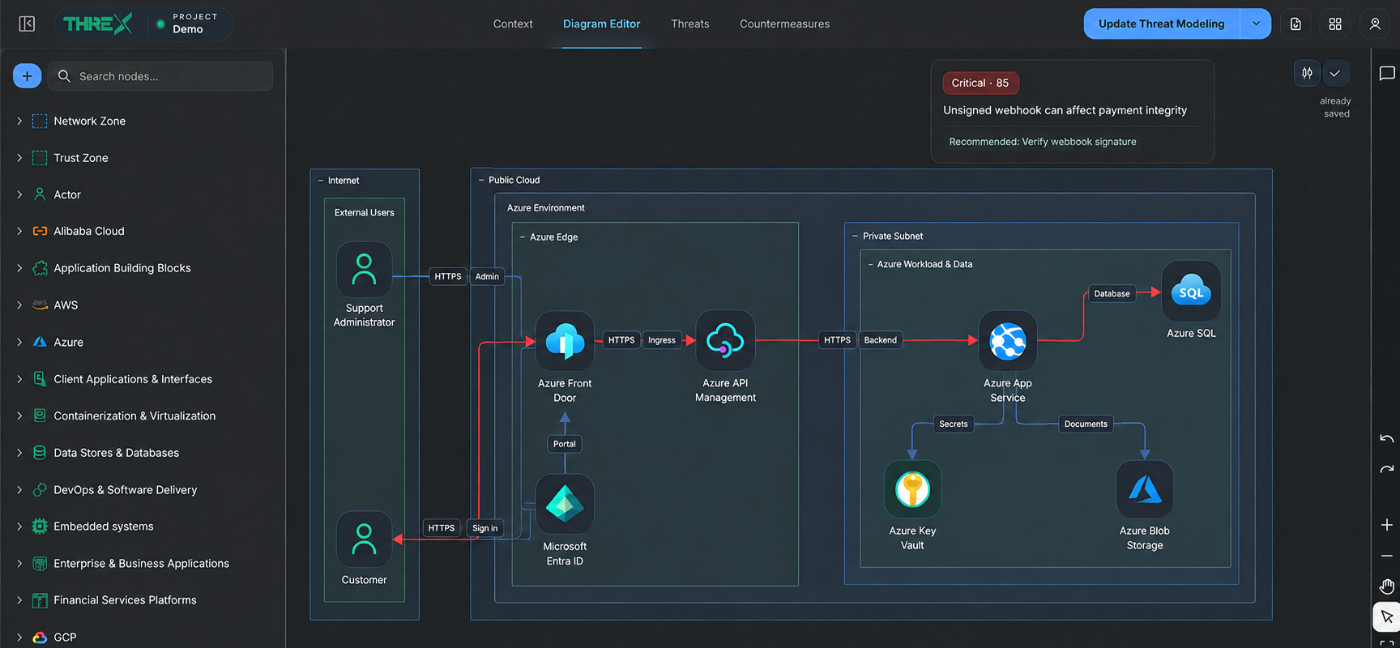
From architecture to prioritized security action

Use cases
Put threat modeling into practice.
Use Threx when a system is being designed, changed or reviewed, from early architecture decisions to recurring security assessments.
-
Review a new architecture
Assess a new application, service or system design before implementation. Identify relevant threats early and give engineering teams clear security guidance.
-
Keep threat models up to date
Reassess risks as architectures, dependencies, code and business requirements change. Keep security decisions aligned with the system instead of relying on a one-time assessment.
-
Support secure-by-design reviews
Use threat models to identify security requirements, document key security decisions and provide evidence for secure-by-design and regulatory requirements.
Why Threx
Threat modeling built for better security decisions.
Threx combines business context, transparent risk reasoning and agentic guidance to help teams make better security decisions and turn them into action.
Threx makes risk prioritization transparent. Teams can see what drives each assessment, challenge assumptions and adjust the factors that influence the result.
The Threx security agent guides teams throughout threat modeling — from creating diagrams and investigating threats to refining assessments, improving mitigations and completing key tasks.
Threx combines technical, business and organizational context to understand which threats are relevant and what their actual impact could be.
Threx connects to your codebase, development and cloud environment and to existing tools, so changes in code, architecture and dependencies are reflected in the threat model and relevant risks are reassessed.
FAQ
Frequently asked questions.
Get in touch
Talk to us about threat modeling.
Whether you have a question, want a demo or would like to see how Threx fits your workflow, leave your details and we will reply within two business days.
MESSAGE RECEIVED
Thank you — we will reply within two business days.
We will read your message and respond to it specifically, not with a template.
If it is useful, we will suggest a short call as a next step.